
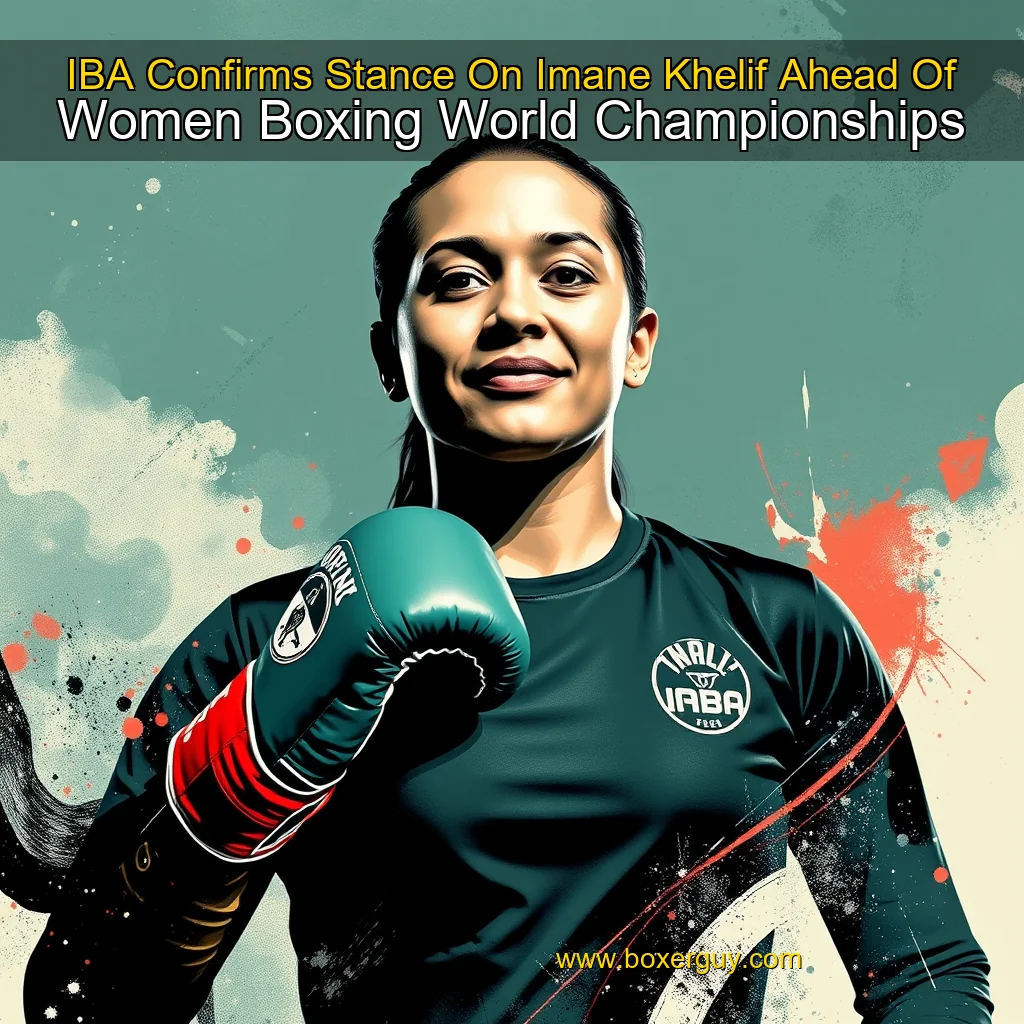
Female Boxers Face Strict Eligibility Criteria to Maintain Integrity of Women’s Boxing Events.
The Background of the Khelif’s Eligibility Issue
Khelif’s eligibility issue stems from a gender eligibility test she failed in 2023. The test, which is a standard requirement for female boxers, assesses the athlete’s biological sex and ensures that they meet the International Boxing Federation’s (IBF) criteria for female boxers. The test is designed to prevent male boxers from competing in women’s events.
The IBF’s Criteria for Female Boxers
The IBF has specific criteria for female boxers, which include:
These criteria are in place to ensure that female boxers are competing against other female boxers and to maintain the integrity of women’s boxing events.
The Consequences of Khelif’s Eligibility Issue
Khelif’s failure to pass the gender eligibility test has significant consequences for her eligibility to compete in the 2025 Women’s World Boxing Championships. As a result, she will not be able to participate in the event, which is a major international competition for female boxers.
The Impact on Khelif’s Career
Khelif’s eligibility issue has a significant impact on her career. She will not be able to compete in the 2025 Women’s World Boxing Championships, which is a major setback for her.
The IOC has since announced that it will not be implementing the IBA’s gender testing rules, which were introduced in 2011.
The Background of the IBA Gender Testing Rules
The IBA, or International Boxing Association, introduced its gender testing rules in 2011. These rules required female boxers to undergo a series of medical tests to verify their sex. The tests included hormone level checks, chromosomal analysis, and other medical evaluations. The IBA claimed that these tests were necessary to ensure that female boxers were not competing against men.
The IOC’s Stance on the IBA Rules
The IOC has taken a different stance on the IBA’s gender testing rules. In a statement, the IOC claimed that the IBA’s rules are “flawed and illegitimate” and that they do not align with the Olympic Charter.
The Controversy Surrounding Gender Eligibility Tests
The Women’s World Championships have been a premier event in the sport of basketball, attracting top talent from around the globe. However, the inclusion of gender eligibility tests has sparked controversy among players, coaches, and fans. The tests, which were introduced in 2019, aim to verify the biological sex of female athletes to ensure they meet the International Basketball Federation’s (FIBA) definition of a female. Key points to consider: + The tests are mandatory for all female players participating in the championships. + The tests are designed to detect and prevent the use of performance-enhancing substances. + The tests are not intended to discriminate against male athletes who identify as female.
The Impact on Female Athletes
The introduction of gender eligibility tests has had a significant impact on female athletes. Many players have expressed concerns about the tests, citing the potential for false positives and the emotional toll of undergoing the tests.


